 English
  Spain
Spain  Deutsch
 GET A QUOTE

Governments and industry leaders worldwide are placing increased focus on supply chain cost reduction and operational efficiency. However, meaningful cost optimization extends beyond vehicle freight rates, fuel expenses, and road tolls, which are already highly transparent and largely fixed. True, long-term cost reduction lies within packaging transformation across the end-to-end logistics lifecycle.
Industrial packaging is undergoing a major shift. Traditional single-use wooden crates and cardboard packaging are increasingly being replaced by returnable, collapsible plastic containers. While legacy industrial markets with deeply entrenched wooden pallet infrastructure face higher friction when updating legacy systems, modern supply chains are moving rapidly toward sustainable alternatives.
Engineered plastic solutions, such as collapsible pallet boxes and sleeve pack systems, offer direct, reusable alternatives to traditional wooden crates. Despite the clear advantages, many enterprises hesitate to alter established packaging workflows out of concern for operational disruption. To mitigate risk, forward-thinking organizations adopt a structured, phased transition strategy.
The migration process typically begins with rigorous sample testing. Enterprises acquire sample collapsible pallet boxes or sleeve packs to evaluate performance directly within their production environment. Technical teams simulate real-world transport conditions through road trials, vertical stacking tests, and impact resilience evaluations. Because replacing core packaging systems represents a major operational shift, this trial phase often spans several months to gather definitive performance data.
Following successful sample validation, companies initiate small-batch deployment rather than an immediate, full-scale overhaul. These initial units are typically integrated into new project lines or used to replace wooden crates reaching the end of their service life. This measured approach offers distinct advantages:
Capital outlay is distributed gradually, avoiding premature disposal of functional wooden assets.
Operational teams and warehouse staff gain time to adapt to new handling procedures, protecting workflow productivity.
Logistics managers can verify supply chain integration and stability under real operational conditions without systemic risk.
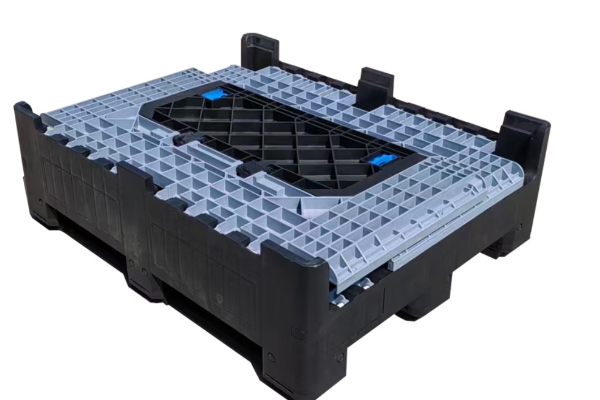
After running small-batch pilots, organizations analyze key operational and financial metrics. Data consistently demonstrates that returnable, collapsible plastic containers significantly reduce long-term logistics costs compared to disposable wooden or cardboard alternatives. Depending on supply chain scale, the full transition typically takes between one and three years. As annual cost reports highlight the lower Total Cost of Ownership achieved through reusable packaging, enterprise support naturally shifts toward full-scale plastic container adoption.